Behavioral health
Moving a solo therapy practice's records into one EHR after a HIPAA risk assessment
A HIPAA security risk assessment found a therapist's client records in three places. SaberGuard moved all 21 charts into SimplePractice under a signed BAA, then rebuilt the security around them.
- Client
- Solo behavioral health therapy practice
- Industry
- Behavioral health
- Team size
- 1
- Services
- HIPAA security risk assessment, EHR migration, IT services and support
The situation: records in three places
The practice is one therapist, who also owns it. When SaberGuard took the practice on, the first piece of work was a HIPAA security risk assessment. It showed a lot of gaps, and the biggest was where the client records lived.
What the assessment found
- Some charts were on paper.
- Some were files on the therapist's laptop.
- Some were in Practice Fusion, under another practice's account.
Records split like that are hard to protect and hard to account for. The other gaps the assessment found, in accounts, backups, devices and the office network, are covered below.
Moving 21 charts into SimplePractice
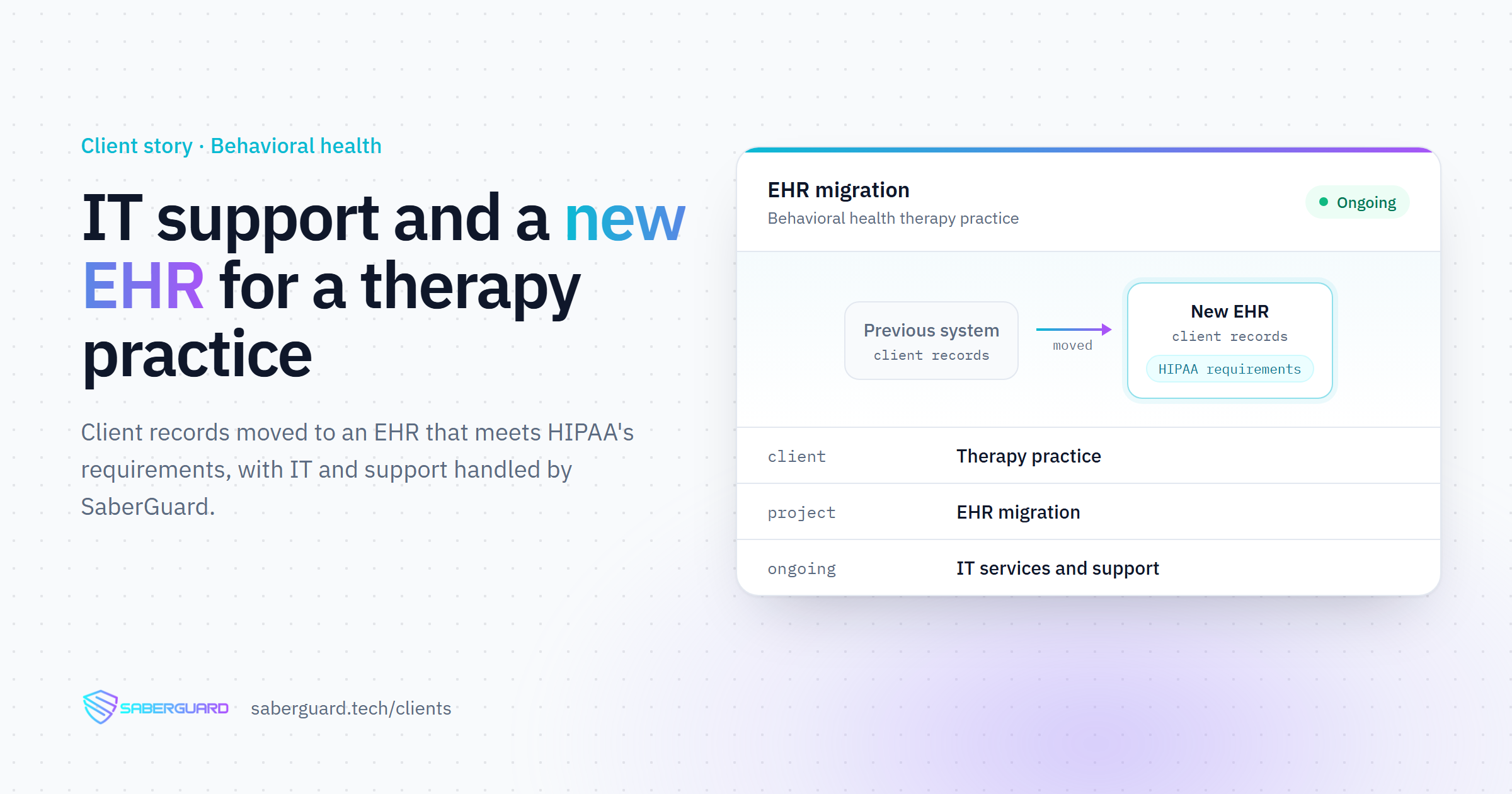
The practice moved to SimplePractice as its EHR, with a business associate agreement signed with the vendor.
SaberGuard moved the records of all 21 clients by manual export and import, working one-on-one with the therapist throughout, then spot-checked charts in SimplePractice to confirm the records had come across intact.
What else changed
With the records in one place, SaberGuard worked through the rest of the assessment:
- Multi-factor authentication on the practice's accounts
- A regular schedule for reviewing account activity
- Backups of the EHR data, and new backups of the client files kept on the practice's computers
- Endpoint detection and response on the practice's devices
- Security event logging and monitoring
- A new business-grade firewall and secured Wi-Fi
Where it stands
The practice works entirely in SimplePractice. SaberGuard handles its IT week to week, which mostly means software problems and the occasional locked computer after too many wrong PIN attempts. Work on the rest of the assessment's findings continues.